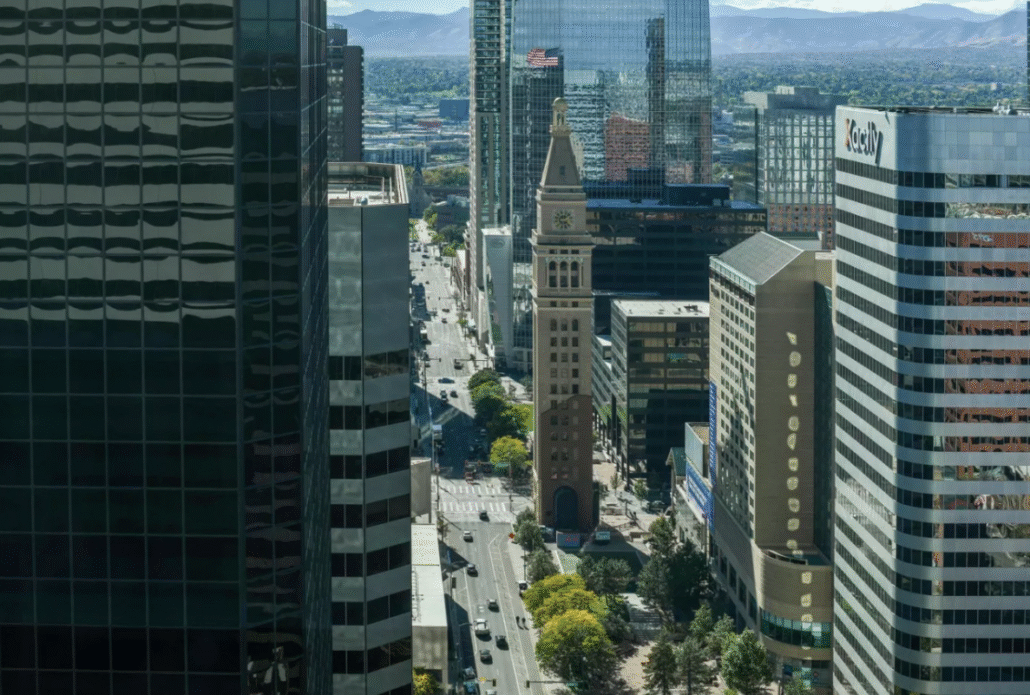
Distressed-Asset Deals Fuel Denver Office Investment, Brokers See Signs of Rebound
Bisnow
September 1, 2025
Jonathan Rose
Denver’s office market is moving again. Buyers of distressed properties are stepping in as values
reset, and that activity is giving brokers reason to call it a rebound.
Real Capital Solutions, a Louisville, Colorado-based investor, has more than $1B in offers out on
office buildings nationwide, including in Denver.
The firm’s strategy is built on buying at steep discounts, with CEO Marcel Arsenault calling 2025
to 2027 a “once-in-a-decade” window for acquisitions. RCS has already obligated $2.6B of the
$3.5B it plans to deploy by 2027.
That same activity is what Avison Young points to as evidence of recovery. Its midyear report
shows Denver office investment volume up 250% year-over-year, with $636M trading across 42
deals. The brokerage highlighted end-user purchases like Bet365’s $135M buy of 1701 Platte
St. as a signal of confidence.
The two perspectives land on opposite ends of the spectrum: One sees a safe entry point
before a recession, the other sees the start of a turnaround. But both agree that sales
of distressed offices are unclogging the system, creating momentum in a market that had been
at a standstill.
“We watch the signs carefully,” Arsenault told Bisnow. “When things look like they don’t make
sense, then they probably don’t make sense, and you need to get out of the market.”
His firm sold 26 office properties in the last four years, he said.
The wave of delinquency is forcing lenders to sell, creating the very discounts RCS is chasing.
Denver’s recent delinquency surge underscores the contrarian bet. The city now ranks sixth
nationally for CMBS office delinquencies, at 27.2%, nearly triple the U.S. average, according to
Trepp. Assets like Industry RiNo Station and the World Trade Center towers are already in
receivership or seized by the lender.
Avison Young’s first-half report shows Denver logged $3.1B in transactions across all asset
types, a 29% year-over-year increase.
“The steepest discounts are in the rearview mirror,” AY principal and Head of U.S. Investment
Sales James Nelson told Bisnow.
That split shows up in individual deals. Wells Fargo Center sold at a deep discount of about $90
per SF, according to Bloomberg and AY. That compares to the $539-per-SF Bet365 deal.
“The real positive news is that these are companies that are taking a permanent presence and
establishing roots,” Nelson said.
The return to the office is trending up, according to AY data. Its Office Busyness Index shows
Denver ranked No. 4 nationally for year-over-year office occupancy growth, with a 110%
increase from mid-2024 to mid-2025. Still, the city sits at 66% of prepandemic levels, middle of
the pack nationally.
Conversions remain a major pressure valve. CBRE data shows conversions and demolitions are
now outpacing new construction in Denver. Mayor Mike Johnston has set a goal of converting
4M SF of offices into housing, equal to more than 10% of the downtown inventory.
AY highlighted Asher Luzzatto’s 700-unit conversion at 621 and 633 17th St. as a case study in
making the numbers work.
Where the two firms diverge is outlook. AY cited Denver’s long-term migration, population
growth and more than $1.2B in downtown infrastructure projects as tailwinds.
“Denver is still a top 10 investment market, and fundamentals are improving,” said Katie
Kruger, AY’s Colorado market leader.
Arsenault is less optimistic. He predicts multifamily oversupply, housing price declines and a
looming recession.
“Most people buy at the wrong time because it isn’t their money,” he said. “For us, it’s my
money. That’s why we’re cautious, but this is when we get aggressive.”